Hospitals & Healthcare
The hospital of 2026 is no longer defined by sterile waiting rooms and confusing corridors. It is defined by intelligence. As patient expectations rise, healthcare providers are aggressively investing in new technology in healthcare to solve age-old operational friction.
From AI agents that handle paperwork to apps that remember exactly where you parked, health tech trends are reshaping the patient journey. For hospital administrators, the goal is simple: reduce anxiety, improve flow and secure the environment.
Here are the top 7 hospital technology trends transforming the medical campus into a smart hospital.
1. Blue-Dot Indoor Navigation
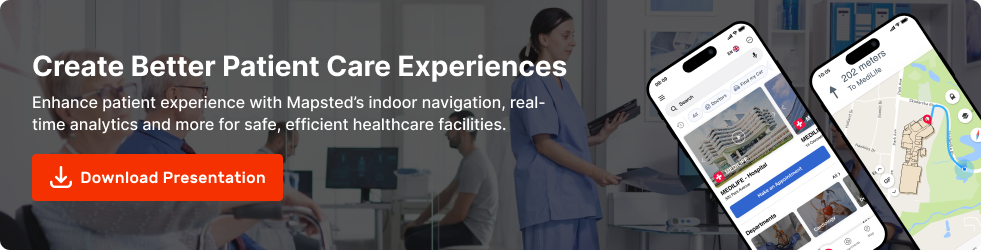
Hospitals are notorious for their complex, maze-like layouts. In 2026, hospital wayfinding has evolved beyond static wall signage. Facilities are adopting “blue dot” mobile navigation, similar to GPS but built specifically for indoors.
- How it works: Patients open the hospital app to see their real-time location as a blue dot on a digital map.
- The Benefit: The app provides turn-by-turn directions to specific clinics, radiology labs or patient rooms. This drastically reduces late arrivals and anxiety, ensuring patients focus on their health rather than getting lost.
2. “Where is My Car?” (Smart Parking Locators)
One of the most stressful parts of a hospital visit often happens after the appointment: trying to find the car. Hospitals are deploying “Where is My Car?” features to solve this common pain point.
- The Problem: Patients and visitors often park in massive, multi-level garages in a rush. Hours later, finding the vehicle becomes a time-consuming frustration. When someone parks a vehicle and wants to return to it later, this technology guides them straight there without wasting time searching when they are already in trouble.
- The Solution: Using the hospital’s app, users can save their parking location with a single tap upon arrival. When leaving, the feature guides them directly back to their exact spot using the most efficient walking route.
3. Operational Heat Mapping
To improve efficiency, hospitals are turning to heat mapping technology. This new technology in healthcare visualizes the movement of people and assets within the facility.
- Usage: It identifies bottlenecks in real-time, such as overcrowding in the ER waiting room or congestion in pharmacy lines.
- The Outcome: Administrators can redeploy staff instantly to busy areas, improving patient flow and reducing wait times. It transforms hospital technology from reactive to proactive.
4. Geofencing for Safety and Asset Tracking
Geofencing creates virtual perimeters around specific zones in the hospital, triggering alerts when crossed. This is a critical component of the modern smart hospital.
- Patient Safety: It protects vulnerable patients, such as those with dementia or Alzheimer’s. If a patient wanders outside a designated safety zone, staff receive an immediate alert.
- Asset Protection: High-value equipment like ventilators or wheelchairs can be tagged. If they leave a specific department without authorization, security is notified instantly.
5. Agentic AI for Workflow Automation

While AI has been a buzzword for years, 2026 sees the rise of Agentic AI. Unlike passive tools that just analyze data, these AI agents can actively perform tasks.
- Application: These agents automate rote work like scheduling, analyzing insurance denials and drafting appeals.
- Impact: This frees up clinicians and administrative staff to focus more on patient care rather than paperwork.
6. The Smart Care Continuum
Patients now expect the same seamless digital experience in healthcare that they get from banks or airlines. The trend is moving toward a connected “Smart Care Continuum.”
- Seamless Transition: This technology ensures that data follows the patient. If a patient moves from a specialist to a hospital, their records and appointments update globally, preventing lost information or wasted appointment slots.
- Patient Portals: Enhanced portals now offer digital intake and self-scheduling, making the hospital technology experience frictionless.
7. Advanced Data Governance and Security
With the explosion of AI, hospitals are doubling down on data governance. You cannot have a smart hospital without clean, secure data. The industry consensus is clear: About 70% of healthcare CXOs believe investing in technology platforms for digital tools and services will be important for their organizations to maintain this level of security and efficiency.
- The Driver: New compliance requirements and the threat of ransomware are forcing hospitals to modernize their cybersecurity foundations.
- The Strategy: Hospitals are focusing on “Minimum Viable Data Governance” to ensure that the data feeding their AI tools is accurate, private and secure.
Conclusion: The Patient-Centric Future
The health tech trends of 2026 are not just about gadgets; they are about empathy. By investing in hospital wayfinding, smart parking and AI automation, providers are telling patients: “We value your time and your peace of mind.”
As hospitals continue to modernize, the gap between “clinical care” and “customer service” is disappearing. The result is a healthcare environment that is safer, smarter and infinitely more welcoming. If you found this blog helpful, please read our blog on “Revolutionizing Healthcare: A New Era of Patient-Centred Care with Design and Technology Innovations” or watch our video on “Maximize Hospital Efficiencies With Location Technology.”
Frequently Asked Questions
Q1. What are the top health tech trends for 2026?
Ans. The top health tech trends include Agentic AI for automation, blue-dot hospital wayfinding, smart parking locators and operational heat mapping to improve patient flow.
Q2. How does hospital wayfinding technology work?
Ans. Hospital wayfinding uses indoor positioning technology to provide turn-by-turn directions on a mobile app, guiding patients from the parking lot to their specific appointment room.
Q3. What makes a “smart hospital”?
Ans. A smart hospital uses interconnected hospital technology like IoT sensors, AI and geofencing to automate workflows, improve patient safety and optimize building efficiency.
Q4. How does geofencing improve hospital safety?
Ans. Geofencing creates virtual boundaries. If a vulnerable patient (like someone with dementia) or a piece of expensive equipment leaves a safe zone, the system instantly alerts security staff.
Q5. Why is “Where is My Car” a critical feature for hospitals?
Ans. Hospital parking garages are large and confusing. This feature reduces stress by allowing patients to save their parking spot on an app and get guided back to it after their visit, solving a major pain point in the patient journey.