


IoT Solutions
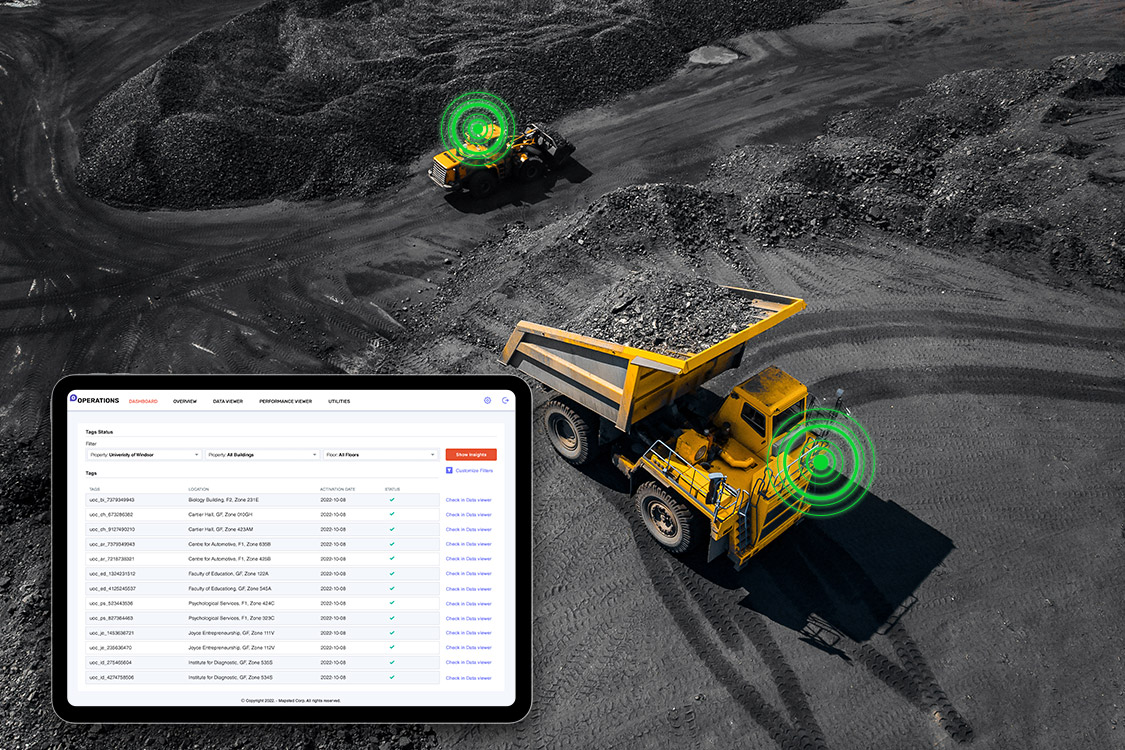
Asset tracking is knowing what equipment your organisation owns, where each item is, and whether it is being used. An asset tracking system does that automatically — tags on the assets, readers or receivers that detect them, and software that turns the raw detections into a register you can query. It replaces the spreadsheet that was accurate on the day it was written and has been drifting ever since.
This guide covers how asset tracking works, the difference between periodic and real-time visibility, how to choose between the technologies, what asset tracking actually returns, and the mistakes that make these projects stall.
How an asset tracking system works
Three components, whatever the technology underneath:
- A tag on the asset. A barcode or QR label, an RFID tag, or a battery-powered tag that transmits on its own. The choice determines whether location updates when someone scans it, or continuously.
- Something that detects the tag. A handheld scanner, a fixed reader at a doorway, or receivers distributed through the building.
- Software that holds the register — what each asset is, where it was last seen, who has it, when it is next due for service, and how often it is actually used.
The third part is the one that determines whether the project succeeds. Detections are easy to generate and easy to ignore. A tracking system earns its cost when the register drives a decision — do not buy another, service this one, this department is hoarding.
Periodic versus real-time: the distinction that matters
Most organisations already do asset tracking of a kind: an annual or quarterly audit, someone with a scanner and a clipboard. The question is not whether to track but how often the record is true.
| Periodic audit (barcode / manual) | Real-time tracking | |
|---|---|---|
| Accuracy of the register | True on audit day, decaying after | Continuously current |
| Labour | High, recurring, manual | Front-loaded into tagging |
| Answers “where is it now?” | No | Yes |
| Answers “is it being used?” | No | Yes — this is usually the valuable one |
| Detects loss | At the next audit, possibly months later | When it happens |
| Cost | Low capital, high ongoing labour | Higher capital, low ongoing labour |
How wrong does a periodic register get? The Auburn University RFID Lab benchmarks retail inventory accuracy, and reports that a typical “exact match” rate — the proportion of SKUs where the recorded count equals the actual count — sits at 55% to 65%. That is the baseline a manual process produces in practice, and there is little reason to expect a spreadsheet of equipment to do better.
The same lab, with GS1 US, ran a study across more than a million items and five retailers and found that 69% of orders shipped between brands and their retail partners contained data errors, against 99.9% order accuracy where RFID was used. Auburn RFID Lab / GS1 US, 2018
Choosing the technology
The honest way to choose is to start from the question you need answered, not from the technology.
| Technology | Gives you | Trade-off |
|---|---|---|
| Barcode / QR | A record when someone scans | Cheapest tags by far; depends entirely on human discipline |
| Passive RFID | Bulk reads at portals and checkpoints, no tag battery | Short read range; needs readers where assets pass |
| Active RFID | Long range presence detection | Battery; cannot give sub-metre accuracy |
| BLE | Room and zone level, continuous | Battery; accuracy varies with obstructions |
| UWB | Coordinate-level, tens of centimetres | The largest infrastructure and cost commitment |
| GPS / LPWAN | Outdoor and between-site tracking | GPS does not work indoors; LPWAN is coarse |
For measured accuracy figures with sources for each of these, see our RTLS guide. Two of them have dedicated articles: RFID asset tracking and how asset tagging captures data.
The most common and expensive mistake is over-specifying accuracy. “Which building and floor is it on, and has it moved this month” is answered at zone level for a fraction of the cost of coordinates. Very few asset questions genuinely need to know where something is to within 30 centimetres.
What asset tracking actually returns
Utilisation — usually the biggest line
Most organisations do not know what proportion of their equipment is in use at any moment, so they buy against peak anxiety rather than measured demand. Utilisation data frequently shows the fleet is large enough and badly distributed. That turns a capital request into a redistribution exercise, which is a much cheaper answer.
Search time
The most visible benefit to the people doing the work. In healthcare, where this has been studied properly, a hospital tracking beds and equipment measured an 86.8% reduction in equipment search time alongside a 20.9% cut in delivery time. Huang TL et al., Int J Qual Health Care 2025
Loss, shrinkage and rental
Items genuinely walk, but more often they are somewhere on site and unfindable — and the organisation rents a replacement at short notice. Rental invoices are the easiest place to look for evidence, because finance already holds them.
Maintenance, compliance and audit
Scheduled servicing requires finding the item first. Usage data allows servicing by running hours instead of the calendar, and a complete location history answers audit and recall questions as a query rather than a search of the building.
Real-time asset visibility software: what to look for
The hardware gets the attention and the software determines whether anyone uses the system. Questions worth asking:
- Does it integrate with the system of record? CMMS, ERP, EAM or clinical engineering. A parallel asset register that disagrees with the official one creates work rather than removing it.
- Can it alert, not just display? Asset left a zone, unused for 30 days, service due, battery low. A dashboard requiring someone to remember to look is a dashboard nobody looks at.
- Does it report utilisation, not only location? This is where the financial case lives, and not every platform computes it.
- Can you export your own data? Location history is the asset; make sure it is portable.
- How are tags provisioned and retired? The administrative workflow around thousands of tags is what decays first.
Why asset tracking projects stall
- Partial coverage. If part of the site is not covered, “not found” is ambiguous — absent, or unmonitored? Staff stop trusting the register and go back to searching.
- The tag register rots. Tags fall off, assets are retired, batteries die. Without a named owner, the system becomes confidently wrong within a year, which is worse than obviously absent.
- No baseline. Without pre-deployment numbers for search time, utilisation and rental spend, the benefit cannot be demonstrated and the renewal conversation is an argument about impressions.
- Accuracy over-specified. Budget consumed on coordinates for questions that were zonal.
- No workflow change. Visibility that alters no decision is a recurring cost with no return.
Where Mapsted fits
Mapsted Tag provides indoor asset tracking with real-time location, movement history and utilisation reporting; Mapsted Badge does the same for personnel. Both use Mapsted’s own positioning rather than depending on beacons, Wi-Fi or anchor infrastructure installed through the building, with Mapsted Flow-Lite available where coverage needs extending. A tag still goes on the asset — that is true of every system — but the in-building installation programme and its maintenance do not.
If you are evaluating this properly you should ask us exactly how the positioning and data path work for your building, and hold us to a site survey rather than a claim on a web page. That is the right question to put to every vendor on your list, including this one.
Where that trade-off does not favour us is the top accuracy tier: if you need dependable centimetre-level coordinates, a dense UWB anchor deployment is purpose-built for it. For the zone and room-level questions that cover most asset tracking, avoiding the infrastructure is usually the larger practical win. Tell us what you need to find and we will tell you which tier it is.
Frequently Asked Questions
What is asset tracking?
Recording and monitoring the location, status and usage of physical assets — equipment, tools, vehicles, inventory — using tags on the items and software that maintains the register. It replaces manual audits with a record that stays current.
What is an asset tracking system?
The combination of tags, detection hardware and software. The tag identifies the asset, the hardware detects it, and the software turns detections into something you can query, report on and act on.
What is the difference between asset tracking and real-time asset visibility?
Asset tracking covers any method of maintaining the register, including periodic barcode audits. Real-time visibility means the record updates continuously without anyone scanning, which is what makes “where is it right now” and “is it in use” answerable.
How accurate does asset tracking need to be?
For most organisations, zone or room level. Coordinate-level accuracy demands substantially more infrastructure and is justified only by specific cases such as tool positioning on a production line. Specify from the question you need answered.
What does asset tracking cost?
It depends on asset count, the area to be covered and the accuracy tier, and those three vary so widely that a published figure would mislead. The useful approach is to price two or three options against your own asset register and floor area, and to compare them on total cost including tag replacement and any in-building installation.


