


Universities & Colleges

The pandemic impacted technology trends in higher education more than any event in the last decade. Universities and colleges had to adopt new technologies at an unprecedented pace with the sudden shift to remote learning. Now, as we enter a new era of higher education, there is one question that lingers. Which education industry trends will stick and which ones will fade away?
Did you know that by the end of 2025, the global ed-tech market is projected to be worth $404 billion? With the rapid advancement of technology, the future of higher education is looking more digital than ever.
In a rapidly evolving technological landscape, transformation drives growth. Staying updated with educational innovations and future learning technology trends (also known as “ed-tech”) is critical to ensure the delivery of quality education.

By developing a deep understanding of these digital trends in higher education, educators and administrators can make data-driven decisions. This can help them learn to integrate the right technology, elevate education standards. Secondly, this will equip students with the essential skills for success in tomorrow’s workforce. Staying on top of the latest ed-tech trends can provide a strategic advantage for students, educators and administrators alike. What’s more, it will also enable them to stand out in a competitive marketplace and achieve exceptional educational outcomes.
Elevating Education: Trends in 2025 and Beyond
Let’s explore four of the most promising innovations and emerging trends in higher education to embrace this year and beyond.
1. Digitally Personalized Learning
Personalized learning is an innovative teaching model. It tailors the learning experience to the unique requirements, strengths, interests and preferences of each student. This can be achieved by acknowledging that learners have diverse learning styles and abilities. Hence, personalized learning aims to provide an educational experience that optimizes their full potential.
Arizona State University (ASU) implemented a personalized learning program that allows students to complete courses at their own pace. In addition, the support of online learning resources and personalized coaching is also offered. ASU’s program combines adaptive learning technology, data analytics and a competency-based curriculum. This provides students with personalized learning experiences that align with their individual needs and interests. As a result, ASU has seen increased student engagement, retention and graduation rates.
The overarching goal of personalized learning is to foster student engagement, motivation and achievement. A more relevant, immersive and effective learning experience is needed for the same. This should also align with their distinctive needs and aspirations.
2. Artificial Intelligence (AI) and Machine Learning (ML)
AI and ML will help educational institutions advance with context-based decision-making in 2025. We’ve already seen how AI and Ml transform businesses by adding agility and efficiency to their process. In the education sector, it’ll carry over the same efficiency to enhance teaching methodology, student engagement and administrative tasks.
The best way AI and ML can transform higher education is through the use of intelligent tutoring systems (ITS). ITS refer to AI-powered systems which provide students personalized feedback and guidance them based on individual learning needs. These systems can analyze students’ performance data, identify their strengths and weaknesses. This helps provide students with targeted recommendations on how to improve.
For example, Georgia State University (GSU) used predictive analytics to improve graduation rates for its students.
GSU developed a predictive analytics system that analyzed students’ academic data. This further helped identify those who were at risk of dropping out. Students recieved targeted interventions, such as advising, tutoring and financial assistance, which helped improve their academic performances. As a result, GSU’s graduation rates increased by 22 percent over the course of six years.
3. Immersive Learning
Immersive learning as an upcoming trend creates a highly engaging and interactive learning environment. This uses technologies such as virtual reality, augmented reality and mixed reality. It differs from traditional classroom learning in that it is an active, experiential, multisensory and highly flexible learning experience. It engages students and allows them to practice skills, solve problems and apply knowledge in the real world. This can improve learning dynamics and prepare students for the future. By providing a more engaging and personalized learning experience, immersive learning has the potential to revolutionize higher education. It will also transform the way students learn.
Case Western Reserve University uses mixed reality to teach anatomy. Students can use the Microsoft HoloLens headset to visualize and interact with 3D anatomical models. This provides a more immersive learning experience. This immersive learning strategy offers four key styles:
- Active Learning: Immersive learning is an active learning experience that allows students to participate in the learning process by engaging with the content and exploring the environment. In contrast, traditional classroom learning is often passive, with students sitting and listening to lectures or reading textbooks.
- Experiential Learning: Immersive learning provides students with an experiential learning experience where they can practice skills, solve problems and apply knowledge in actual scenarios. This allows students to gain hands-on experience that is often difficult to achieve in a traditional classroom setting.
- Multisensory Learning: Immersive learning engages multiple senses, including sight, sound and touch, to create a highly practical and involved learning experience. This can help students retain information better and improve their learning outcomes.
- Flexibility: Immersive learning is highly flexible and can be adapted to meet the individual needs of each student. Students can progress completely unrushed and receive personalized feedback and support.
4. Location-Based Intelligence Technology
Our list of higher-education future technology trends for 2025 and beyond is not yet complete without location-based intelligence technology. So why is it important? Location-based intelligence technology can offer numerous benefits and uses on campuses, some of which are:
Navigation
Campus maps can be created using location-based intelligence, which can help students and visitors to navigate and find their way around the campus. This technology is the secret sauce to providing turn-by-turn directions to a particular location on the campus.
Safety
Location-based intelligence technology can be the key to providing safety and security on campus by tracking the location of students, staff and visitors within a meter. This can be particularly useful during emergencies such as a fire outbreak or a natural disaster.
Student Engagement
Location-based technology can be used to engage students in campus activities and events by sending notifications and reminders based on their live location.
Personalized Services
Location-based intelligence can be used to provide personalized services to students based on their location. For example, students can receive recommendations on nearby restaurants, study spots or events based on where they are on campus.
Resource Management
Location-based technology can help campus administrators to manage resources more efficiently. For example, it can be used to track the location of equipment and personnel, which can help to optimize resource utilization.
Marketing
Location-based intelligence can be used by businesses on campus to market their products and services to students and staff. For example, a café on campus can send notifications to students when they are nearby, promoting their daily specials.
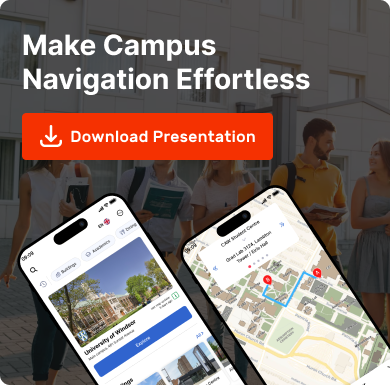
The transition to campus life can be a daunting experience, causing undue stress and anxiety for many new students. But with Mapsted’s innovative location technology for universities, there’s a supportive digital solution that can help students feel supported and on track. Mapsted’s wayfinding solution is a perfect example that goes beyond traditional maps by providing real-time location information and contextual awareness through an intuitive smartphone interface.
The University of Windsor has implemented Mapsted’s technology and is thrilled with the results. The university named the app CampusGo and it has been helping students navigate the university campus since 2021.
“Finding a classroom in a growing institution with over 40 buildings can sometimes be a challenge,” says Jennie Atkins, who along with Emmeline Ventimiglia led the project to bring wayfinding technology to the UWindsor campus with support and implementation from Facility Services and Information Technology teams. “With CampusGo, you can quickly select your desired destination and it will provide turn-by-turn directions right to the appropriate door.”
Campus accessibility is also highlighted through the CampusGo app. As a result when you open the app, accessible entrances and parking are listed, along with general safety and convenience items such as the location of campus emergency call stations and visitor parking.
Summing up
The COVID-19 pandemic forced universities and colleges to adopt new technologies and turned the landscape around for educators, students and universities. As we enter a new era of higher education, it’s essential to understand which trends will stick and which ones will not. By exploring four promising higher education industry trends: personalized learning, artificial intelligence (AI) and machine learning (ML), immersive learning and location-based technology, we’ve covered present and upcoming innovations. By embracing these trends, educators and administrators can enhance the learning experience, equip students with essential skills for success in the workforce and achieve exceptional educational outcomes.
These trends are expected to enhance the teaching methodology, student engagement and administrative tasks and prepare students for the rapidly changing demands of the workforce. To stay ahead of the competition and embrace campuses of the future, leverage Mapsted location technology to prepare your university for rapid innovations in the education sector. Our solution balances digital and physical experiences, enhancing your prestige and value proposition for future generations of students. If you enjoyed learning about how technology will impact campuses in the coming years, you may enjoy this short video and this blog covering some characteristics of an ideal university.
Frequently Asked Questions
Q1. What are the top technology trends in higher education for 2025?
Ans. The top technology trends in higher education for 2025 include personalized learning, artificial intelligence (AI) and machine learning (ML), immersive learning and location-based intelligence technology. These digital trends in higher education aim to improve student engagement, teaching methodologies and campus management, reflecting the emerging trends in higher education.
Q2. How can personalized learning improve education in higher institutions?
Ans. Personalized learning tailors educational experiences to the unique needs, strengths and interests of each student. By leveraging adaptive learning technologies and data analytics, institutions can offer customized learning paths. This innovative approach is an example of innovation in higher education, enhancing student engagement, retention and academic performance, in line with education industry trends.
Q3. What role does AI and ML play in the future of higher education?
Ans. AI and ML in higher education play a crucial role in transforming learning. These technologies enable intelligent tutoring systems (ITS) to provide personalized feedback, enhance teaching methodologies and improve student outcomes. With the integration of emerging trends in higher education, AI and ML also help in predictive analytics, improving student performance, retention and graduation rates.
Q4. What is immersive learning and how does it benefit students?
Ans. Immersive learning, powered by technologies like virtual reality (VR), augmented reality (AR) and mixed reality (MR), creates interactive and engaging learning environments. This digital trend in higher education helps students practice skills, solve real-world problems and gain hands-on experience, significantly enhancing the learning process and contributing to the trends in higher education.
Q5. How does location-based intelligence technology improve campus life?
Ans. The organization provides energy-efficient tools and real-time monitoringLocation-based intelligence technology enhances campus life by offering real-time navigation, personalized services and improved safety. It helps students and visitors navigate campus more efficiently, provides personalized recommendations and ensures safety by tracking locations during emergencies, reflecting education industry trends and innovation in higher education.


