


Hospitals & Healthcare
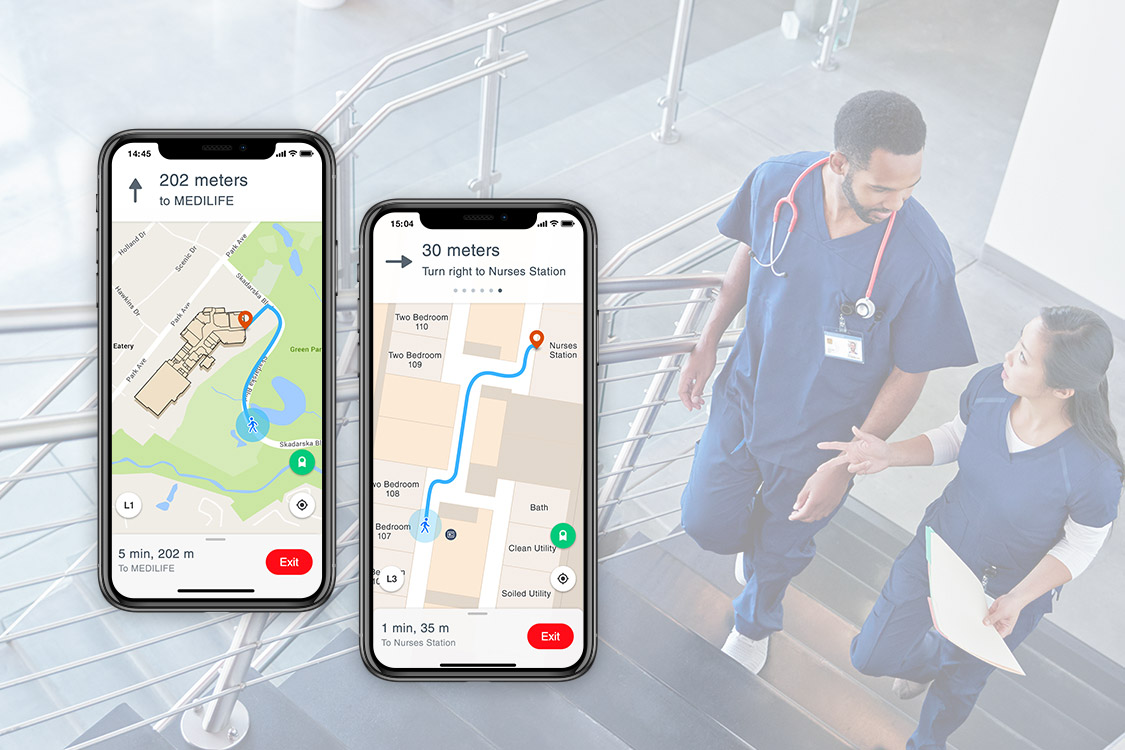
Hospital wayfinding is the system a healthcare facility uses to get patients, visitors and staff from where they are to where they need to be — signage, floor plans, digital kiosks, and increasingly a live blue dot on a phone. It matters because hospitals are among the hardest buildings in the world to navigate: they grow by extension rather than design, departments move, and most people arriving are anxious, unwell or late.
This guide covers what a hospital wayfinding system actually is, what poor wayfinding costs in measured staff time, how digital wayfinding differs from signage, what to look for when comparing solutions, and how to roll one out. It does not quote system pricing — that depends entirely on the size and complexity of your estate, and any figure published without seeing your floor plans would be a guess.
What hospital wayfinding actually costs
In our experience of these projects, wayfinding tends to be treated as a signage budget line. The measured evidence suggests it behaves like an operational one.
The most recent peer-reviewed data comes from a 2025 survey of 301 US hospital staff published in HERD: Health Environments Research & Design Journal. Its findings are specific:
- Each staff member spends around 30 minutes every week helping other people find their way.
- Nearly 44% of staff reported experiencing incivility from people who had become frustrated by wayfinding problems.
- The five places people most often need help finding are mundane: the cafeteria, restrooms, elevators, exits and the main lobby.
- Staff frequently stop what they are doing and escort people part of the way.
- Staff navigate their own department easily and other departments poorly — so the problem is invisible to the people best placed to report it.
That last point is the one worth sitting with. Wayfinding failures are absorbed by staff in thirty-second increments that never appear in any system of record. Thirty minutes per person per week is roughly 26 hours a year, per employee — in a 2,000-person hospital, the equivalent of around 25 full-time roles doing nothing but giving directions.
Source: Jamshidi S, Hashemi S, Tran DT. Costs and Effects of Ineffective Wayfinding in US Hospitals: A Survey of Hospital Staff. HERD. 2025;18(2):463–479.
A note on the figure everyone quotes
You will see “hospital wayfinding costs $220,000 a year and 4,500 staff hours” repeated across almost every article on this subject, usually without a date. It traces to Zimring, C., The costs of confusion: non-monetary and monetary costs of the Emory University hospital wayfinding system, Georgia Institute of Technology, 1990 — a single 604-bed tertiary hospital. The original report is not online; the figure is quoted and attributed in a 2022 PLoS One paper, which is where we read it and which is what the link above goes to.
It is a real study and the mechanism it describes still holds. But it is one hospital, thirty-six years ago, and presenting it as a current industry benchmark is not honest. We mention it because you will encounter it everywhere; we lead with the 2025 data because that is what current decisions should rest on.
Why hospitals are so hard to navigate

Four things make healthcare buildings a worst case:
- They are accretions, not designs. A hospital is typically a original building plus decades of wings, towers and annexes, each with its own floor numbering and corridor logic. Level 3 in one wing is not level 3 in the next.
- Departments move. Clinical reorganisation happens far faster than signage is replaced, so permanent signs quietly become wrong.
- The people navigating are least able to. Patients are anxious, in pain, medicated, elderly, or supporting someone who is. Cognitive load is already at its limit before the first junction.
- Terminology is insider language. A sign to “Ambulatory Care” does not help someone told to attend “the pre-op clinic”.
This is why adding more signs often fails. Past a certain density signage becomes visual noise and people stop reading it — they look for a person instead. The 2025 survey did not measure sign density, but it did measure the consequence: staff time absorbed by giving directions, and the five destinations people most often cannot find are ones almost every hospital already signposts.
Traditional signage vs digital hospital wayfinding
| Static signage | Digital wayfinding | |
|---|---|---|
| Updating after a department moves | Physical replacement, weeks to months | Edit the map, live immediately |
| Turn-by-turn guidance | No — the visitor navigates between fixed points | Yes — continuous route on the visitor’s phone |
| Accessible routing (step-free, lift-only) | Rarely, and never personalised | Route can be filtered per person |
| Language | One or two, fixed | Whatever the phone is set to |
| Tells you anything about usage | Nothing | Where people stop, backtrack and get lost |
| Works with no phone / no app | Yes | Needs kiosks or printed maps alongside |
The honest answer is that this is not an either/or. Digital wayfinding does not replace signage — a visitor with no smartphone, a flat battery or no inclination to download anything still needs a sign at the junction. What digital adds is a live, personalised, measurable layer on top, and the ability to fix a wrong route in an afternoon rather than a procurement cycle.
What a hospital wayfinding system includes
Indoor maps for hospitals
The foundation is an accurate digital floor plan of every building, level and room, with the relationships between them modelled — which corridors connect, which lifts serve which floors, which doors need a badge. Without this, everything above it is guesswork. Keeping the map current as the building changes is the part most projects underestimate.
Indoor positioning — the blue dot
A map tells you the layout. Positioning tells you where you are on it, which is what makes turn-by-turn possible indoors where GPS does not reach. Approaches differ mainly in what hardware they require: beacon-based systems need physical devices installed and maintained throughout the building, while hardware-free approaches use the sensors already in the phone. For a live hospital, the installation and maintenance burden is often the deciding factor rather than raw accuracy.
Digital kiosks and static signage

Kiosks at entrances and decision points cover everyone who will not use a phone, and can hand a route off to a phone via a QR code. Good static signage remains essential — the digital layer should agree with it, not contradict it.
Integration with the appointment
The highest-value version links wayfinding to the reason the person is in the building: an appointment reminder that contains the route, a check-in that directs them to the right waiting area, a change of room that updates their directions.
Who benefits, and how
Patients and visitors
Arriving on time and unflustered changes the clinical encounter that follows. For people attending regularly — oncology, dialysis, antenatal — the difference compounds across dozens of visits. Personalised routing also protects privacy: a visitor does not have to announce which department they are looking for at a desk in a public lobby.
Clinical and front-line staff
This is where the measured cost sits. Recovering even part of that 30 minutes a week per person returns clinical time, and removes a category of interaction that — per the 2025 survey — leads to abuse from frustrated visitors for nearly half of staff. Wayfinding also shortens orientation for new starters, agency staff and rotating trainees, who navigate an unfamiliar building under pressure.
Facilities and operations
Usage data turns wayfinding from an opinion into a measurement: which junctions generate backtracking, which entrances are misused, where queues build. That evidence informs signage placement, entrance staffing and future capital works. It also means a department relocation can be handled in the map before the move rather than discovered afterwards.
Finance
Late and missed appointments carry a direct cost in idle clinical capacity, and navigation is one contributing cause among several. Be sceptical of vendors — including us — who attribute a headline no-show figure to wayfinding alone: the honest framing is that wayfinding is one lever on a multi-causal problem, and the size of that lever is worth measuring in your own facility before and after.
Accessibility is the requirement, not the extra
A hospital serves, disproportionately, people with mobility, visual, hearing and cognitive impairments. A wayfinding system that routes everyone identically has failed a large share of its users.
- Step-free and lift-only routing as a first-class option, not a footnote
- Screen-reader compatibility and voice guidance for visually impaired visitors
- High-contrast and large-text modes
- Plain, non-clinical language — route to “X-ray”, not “Diagnostic Imaging Suite B”
- Multilingual by default, following the device’s own language setting
How to roll one out
- Map and calibrate the estate. Every building, level and connection, verified on site rather than taken from drawings — which are frequently out of date in exactly the places that matter.
- Decide the positioning approach. The real question is what you are willing to install and maintain in a building that cannot close.
- Start with the worst journey, not the whole hospital. Main entrance to outpatients, or the route the switchboard is asked about most, is a better first phase than full coverage.
- Put it where people already are — the appointment letter, the SMS reminder, the existing hospital app, a QR code at the door. A separate app nobody downloads helps nobody.
- Assign ownership of the map. The most common failure mode is not technical: it is that no one owns updating it, so within a year it is as wrong as the signage it replaced.
- Measure before and after. Time from entrance to destination, late-arrival rate, direction requests at reception.
Questions worth asking a wayfinding vendor
- What hardware must be installed, and who maintains it once we have signed off?
- What happens to accuracy as the building changes — who updates the map, and how quickly?
- Can a visitor get a route without installing an app?
- Is accessible routing a filter on the same engine, or a separate limited mode?
- What does it integrate with — our patient portal, appointment system, existing app?
- What data leaves the building, where is it stored, and how does that sit with our privacy obligations?
- Can you show a comparable deployment at a hospital of our size and complexity?
Where Mapsted fits
Mapsted provides hardware-free indoor positioning and wayfinding: locating a visitor’s phone inside the building needs no beacons or additional hardware installed or maintained on site, using the sensors already in the device. For a facility that cannot close for an installation programme, that is usually the practical constraint. The platform covers indoor maps, turn-by-turn navigation, accessible routing, kiosks and location analytics, and is designed to sit inside an existing hospital app rather than requiring a separate download.
To be clear about scope: this is wayfinding for people. Tracking equipment — pumps, beds, wheelchairs — is a different problem that needs something attached to the asset; that is hospital asset tracking, not wayfinding, and the two are often confused in procurement. Talk to us about your facility if you want to work through what either would involve for your estate.
Frequently Asked Questions
What is hospital wayfinding?
Hospital wayfinding is the combination of signage, maps, kiosks and digital navigation that helps patients, visitors and staff find their way around a healthcare facility. Modern systems add indoor positioning so a person can follow a live route on their phone, the way they would outdoors with GPS.
How much does poor wayfinding cost a hospital?
The most current peer-reviewed measurement, a 2025 survey of 301 US hospital staff in HERD, found each staff member spends about 30 minutes a week helping others navigate — roughly 26 hours per employee per year. The widely quoted “$220,000 and 4,500 staff hours” figure comes from a 1990 study of a single 604-bed hospital and should not be treated as a current benchmark.
Does digital wayfinding replace signage?
No. Visitors without a smartphone, without charge or without the inclination to use one still rely on signs, so good static signage remains necessary. Digital wayfinding adds a live, personalised and measurable layer, and lets you correct a route immediately when a department moves.
Do patients have to download an app?
They should not have to. Wayfinding works best embedded in something the person already has — the hospital’s existing app, an appointment SMS, or a QR code at the entrance that opens a route in the browser. Kiosks cover visitors who are not using a phone at all.
Does indoor navigation work where GPS does not?
Yes — that is the point of indoor positioning. GPS degrades badly inside large steel-and-concrete buildings — gps.gov lists signal blockage by buildings, multipath reflection and indoor use among its error sources, and publishes no indoor accuracy figure at all — so indoor systems use other signals to place someone on a floor plan. Approaches differ in whether they require hardware installed throughout the building.
How long does a hospital wayfinding project take?
It depends almost entirely on the estate rather than the software: mapping and verifying a multi-building campus is the long pole. A single high-traffic journey can be live far sooner than full coverage, which is why starting with the worst route is usually the better sequencing.


