


Technology Trends

Wi-Fi has become readily available in just about every indoor space, so it may seem like a logical default choice for an indoor positioning system (IPS), but it has security and accuracy setbacks. Nonetheless, despite Wi-Fi’s downsides, let’s investigate whether or not Wi-Fi indoor positioning systems are a worthwhile option to consider as a viable IPS for your indoor space. Because of its widespread availability, it has become a popular option. In fact, according to predictions the value of the global Wi-Fi indoor positioning market will be approximately $19 billion by 2030.
What is Wi-Fi Indoor Positioning?
Wi-Fi location tracking, also known as Wi-Fi-based localization and Wi-Fi-based indoor positioning, uses Wi-Fi signals to determine the location of a device or person within an indoor environment. An indoor positioning system using Wi-Fi relies on the presence of access points (APs) or routers emitting wireless signals. Each Wi-Fi access point relays data allowing access to gain some insights into a user’s location.
How Does Wi-Fi Positioning Compare to GPS?
When we think of location, we may automatically think about Global Positioning Systems (GPS) or Global Navigation Satellite Systems (GNSS). GNSS systems are incredible systems that have been around since the late 1970s and are ideal for locating devices outdoors, achieving under 5-metre accuracy in commercial devices. GPS is great for providing location outdoors, but it has limited potential in indoor environments. That’s where and why alternative location technologies such as Wi-Fi indoor positioning systems come into play.


What is a Wi-Fi-Based Positioning System?

WiFi describes a local wireless network that uses radio waves to communicate data. Typically from the internet. It uses the IEEE 802.1 standard to communicate. There are multiple versions of Wi-Fi as defined in the IEEE specifications, which include common ones such as 2.4 GHz and 5GHz frequency radio waves. Wi-Fi enables transferring large amounts of information, with speeds of up to several gigabits per second for certain versions.
With this in mind, Wi-Fi positioning is a positioning system that uses techniques to locate a connected object or device. Wi-Fi location uses already existing infrastructure and Wi-Fi access points (APs) to calculate where a device is located. The device needs to be able to listen to the Wi-Fi AP but does not need to connect to it. Localization in Wi-Fi positioning systems depends on multiple Wi-Fi signals and knowing where those APs are located.
Wi-Fi’s short-range can roughly be around 150 meters. The accuracy generally depends on the number of APs and the physical environment. Positioning and localization is more precise with more APs in a given area. Wi-Fi can provide about 20m accuracy using existing crowdsourced Wi-Fi infrastructure with no calibration. However, through calibration, surveying, and fine-tuning, Wi-Fi positioning can achieve 5-8 meter accuracy in indoor environments.
How to do WiFi-Based Positioning Systems Work?
There are multiple methods for monitoring indoor positioning using Wi-Fi. The two primary methods are received signal strength (RSS) and fingerprinting. The RSS of a Wi-Fi signal is inversely proportional to distance. The MAC address is unique for each Wi-Fi router and the RSS provides a rough distance from the device. RSS is strong when the user is close to the Wi-Fi AP and weak when the user is far away.
Obstacles like walls, furniture, and people weaken signal strength, posing a challenge to positioning accuracy. Therefore, a weak RSS implies that either the distance or obstacles are hindering the performance.
There are two ways to leverage Wi-Fi MAC addresses and RSSI for Wi-Fi positioning:
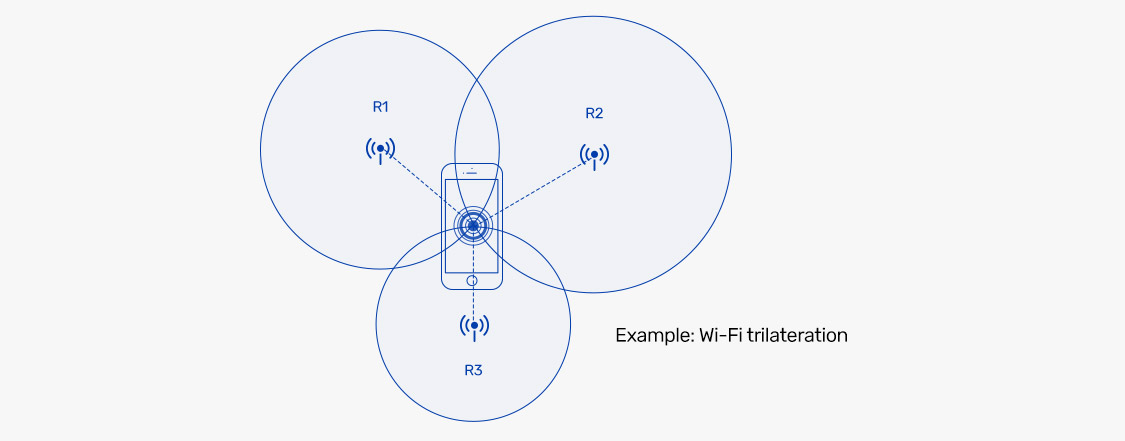
1. Wi-Fi Trilateration. Wi-Fi Trilateration requires knowledge of the location of each Wi-Fi router. Then, based on the RSSI, it estimates the distance between the user and each visible Wi-Fi router and calculates its position based on those distances.
2. Wi-Fi Fingerprinting. This method can significantly improve accuracy. Fingerprinting uses historical RSSI information as well as known locations to determine the position of an asset given its current RSSI values.Fingerprinting is highly dependent on the environment, so updating fingerprint data is necessary by making changes to the environment. Be it moving a small piece of furniture or adding partitions. In addition to RSSI and fingerprinting, Angle of Arrival (AoA) and Time of Flight (ToF) can help determine location.
The angle of Wi-Fi signals reaching the antenna is the AoA. Estimation using AoA uses a multiple-input multiple-output (MIMO) antenna, which clusters antennas together to increase range and throughput. MIMO antenna systems are common in some enterprise environments.
Sometimes, systems use a combination of ToF and AoA, which can result in a very accurate location. AoA systems require correct orientation to work reliably. They suffer from the same noise, sampling artifacts, and multipath channel effects as TOF does, but the requirement for clock synchronization is less of an issue.
While these methods are accurate, they require expensive equipment and methods such as multiple antennae and clock synchronization. Assembling the Wi-Fi fingerprint map can be time-consuming and requires a site survey, but tends to provide more accurate results than Wi-Fi trilateration.
The Pros and Cons of Wi-Fi Positioning Systems
The Pros of Wi-Fi Positioning Systems
Availability
Unlike other indoor positioning solutions such as BLE beacons or RFID, Wi-Fi indoor positioning does not require additional hardware since most buildings already come equipped with Wi-Fi access. Nearly all facilities already have Wi-Fi infrastructure installed, providing a base level of positioning capability without additional investment. Deploying hardware solutions manually is costly and time-consuming, especially if you have multiple facilities that require the capability. As a result, other technologies require a larger budget in both money and time in order to create an effective environment for indoor positioning.
Scalability
Wi-Fi-based indoor positioning systems are easy to scale with little to no manual intervention. For instance, implementing Wi-Fi positioning in 25 warehouses compared to manually deploying BLE beacons or RFID in 25 warehouses is economical. While Wi-Fi positioning provides instant-on capabilities, businesses have several options to improve the accuracy based on the use case requirements.
Flexibility
A simple survey to map the precise locations of all Wi-Fi APs within a facility will improve the positioning accuracy of the system. To improve accuracy, businesses have the option to deploy additional Wi-Fi access points within their facilities. While this does represent an additional expense, it does not require the customer to learn, deploy and maintain yet another technology within their infrastructure. This can be accomplished as part of a general Wi-Fi infrastructure improvement project or by simply adding additional Wi-Fi access points in areas that require additional positional accuracy.
The Cons of Wi-Fi Positioning Systems
Accuracy
The major disadvantage is Wi-Fi positioning system accuracy. With accuracy at the higher end of 15 metres, it may not be as suitable for precise location applications, where Bluetooth excels by comparison with its 2-4 metre accuracy. However, accuracy can reach 2-3 metre in combination with fingerprinting, a significant amount of Wi-Fi access points, and/or combining tracking data with other technologies (also known as sensor fusion). Innovative location technology companies such as Mapsted, however, have developed a hardware-free indoor positioning system that doesn’t just rely on one data source but rather gathers positioning data from more than 50 data points and employs AI and machine learning to create industry-leading accuracy and reliability.
Security
Another disadvantage of a Wi-Fi indoor positioning system is the threat of security breaches. Wi-Fi is such a common technology that it has already experienced numerous hacks and resulting security patches. Security will always be a concern for Wi-Fi, but given this, there will always be companies working to harden Wi-Fi from malicious attacks.
Innovative Wi-Fi Indoor Positioning Alternatives
Wi-Fi indoor positioning systems can be a viable solution for indoor location positioning if you’re willing to compromise on accuracy and security. However, for office complexes, vast shopping malls, hospitals, university campuses, airports, big-box stores and museums, more advanced and accurate location technology such as Mapsted is an innovative alternative. If you found this blog helpful, please read our blog detailing 10 Reasons Why Indoor Location Tracking Makes Businesses More Efficient or watch our video Revealing Mapsted’s Innovative Navigation Technology at The Strong Museum of Play.
Frequently Asked Questions
Q1. Where does Wi-Fi positioning work best?
Ans. Wi-Fi uses access points as leverage for positioning in an indoor or outdoor environment where people congregate in large numbers.
Q2. What is a Wi-Fi positioning system?
Ans. WPS, or Wi-Fi positioning system, is a technology that locates a target in an indoor environment by utilizing the device’s proximity to wireless access points or Wi-Fi devices. This method of localization is less expensive than purchasing expensive hardware.
Q3. What is triangulation using Wi-Fi?
Ans. Wi-Fi triangulation is a technique that uses IEEE 802.11 standards to determine the distance between the target and the access point. The indicator is based on the Received Signal Strength Indicator (RSSI).
Q4. How accurate is tracking with Wi-Fi?
Ans. Wi-Fi achieves an accuracy of three to five meters depending on the line of sight conditions by using Time Difference of Arrival (TDOA). When there are obstacles or targets move through multiple buildings, the accuracy can vary.
Q5. What is Wi-Fi fingerprinting?
Ans. Fingerprinting is a technique for improving Wi-Fi positioning. The location of the Wi-Fi access point should be known ahead of time, and assets with tags should report their signal strength in relation to the nearest AP. This method of determining location is known as Wi-Fi fingerprinting.


