


Transportation Hubs

More than even before, passing through an airport on the way to a destination can be an exciting adventure for travellers. New amenities, shops and services are making airports a destination all on their own! Technology used in airports has also been undergoing a dramatic evolution. Current trends in the airline industry technology will undoubtedly transform the future of air travel like never before. Innovations from AI and Metaverse to sustainable development will not only enhance the passenger experience but also drive business growth within airports.
Smart Airport Technology and Airport Digital Transformation
Smart airport technology is no longer experimental. It is now central to airport digital transformation strategies worldwide. As part of the broader shift toward AI in aviation industry innovation, airports are becoming fully digital, data-driven environments.
These modern hubs integrate IoT sensors, artificial intelligence (AI), cloud platforms and real-time analytics to improve check-in, security, baggage handling and resource allocation. The goal is simple: reduce queues, optimize staffing and improve passenger flow.
In 2026, technology is not just supporting airport operations — it is reshaping how airports function as intelligent transport hubs.
Key Airport Technology Trends Shaping 2026
The airport technology landscape is accelerating toward hyper-automation, data-driven planning and fully integrated airline–airport ecosystems. As airport operations grow more complex, these innovations are becoming essential rather than optional. Here are the standout airport technology trends defining 2025:
- Hyper-automation in passenger processing: Automated bag drops, biometric corridors and self-service security reduce queues and manual interventions.
- AI-powered demand forecasting: Airlines and airports use ML models to predict delays, staffing needs and peak congestion.
- Integrated airline technology systems: Carriers increasingly synchronize flight operations, ground handling and turnaround processes with airport digital platforms, improving time-on-block efficiency.
- Advanced airport technologies for ground operations: Computer vision monitors apron safety, while autonomous tugs and robotic marshalling streamline aircraft movement.
- Sustainability-first terminal planning: Energy optimization platforms, solar-powered infrastructure and smart HVAC systems support net-zero goals.

The Future of Airport Automation and Operations
As aviation demand accelerates, airport automation market trends are pushing facilities toward self-regulating, intelligent environments. Modern airports are adopting:
- Self-correcting operational systems that adjust gate allocation, apron traffic patterns and baggage flow in real time.
- Automated security layers that blend AI-enhanced screening, anomaly detection and behaviour analytics.
- Smart apron optimization tools, reducing taxi time and fuel burn through precise aircraft routing recommendations.
- Cloud-based command centres enabling unified control of terminal assets, IoT sensors and operational alerts.
These advancements transform airport operations from reactive to anticipatory, giving operators stronger control over delays, bottlenecks and safety risks.
Biometric Systems and Seamless Passenger Processing
One of the most visible applications of AI in aviation industry operations is biometric passenger processing. Facial recognition and digital identity systems are now embedded within smart airport technology platforms to speed up check-in, security screening and boarding.
These systems reduce manual document checks and support airport digital transformation goals. They improve throughput without requiring physical expansion. For busy airports, this means faster movement, shorter lines and better passenger satisfaction.
Airline–Airport Integration: A New Era of Collaboration
A major shift in 2025 is the deep integration between airline technology solutions and airport platforms. Seamless connectivity enables:
- Real-time data exchange between airlines and terminals
(turnaround updates, pax volumes, weather impacts, crew status). - Dynamic gate planning based on aircraft readiness and passenger flow.
- Unified disruption management, where airports and airlines coordinate automated rebooking, re-routing and gate changes.
- Predictive fuel and catering logistics, aligned to live aircraft data rather than static schedules.
This removes long-standing operational silos and improves on-time performance across the entire aviation ecosystem.
Airport Technology Management in a High-Demand Future
To keep pace with the future of the airport market, operators must adopt technology management frameworks that support growth, resilience and scalability:
- Modular digital architecture, allowing airports to plug in new systems without massive IT overhauls.
- Cybersecure IoT governance, safeguarding sensors, baggage systems and access points.
- Data orchestration models that merge passenger analytics, operations data, airline feeds and IoT insights into one decision-making layer.
- Tech-enabled workforce augmentation, where staff use AR-guided inspections, smart glasses and AI copilots.
Strong technology management will determine whether airports can scale sustainably and economically in the next decade.
Advanced Airport Technologies Driving Market Growth
The advanced airport technologies market is expanding rapidly as airports invest in:
- Digital twins for predictive scenario modelling.
- Smart queue management, blending sensors with behaviour analytics.
- Autonomous cleaning and safety robots to maintain service standards.
- 5G-driven connectivity is powering instant data transfer between aircraft, gates and control systems.
- Real-time resource optimization for baggage belts, fuel zones and boarding bridges.
These tools increase airport capacity without requiring immediate physical expansion — a major advantage for constrained terminals.
How Can Technology Improve Airport Operations?
Here are seven exciting technological possibilities that await airport pioneers that choose to expand their innovation horizons.
1. Automation and Robotics
New technology in the aviation industry will inevitably include automation and robotics. A report by Mordor Intelligence mentioned that the airport robot market experienced a Compound Annual Growth Rate of 15% by the year 2025. Investing in automation and robots will likely lead to further growth in this sector. Smart robots play a crucial role in eliminating the need for human-manned desks, as they can provide passengers with information and guidance – whenever, wherever. Additionally, they are beneficial in enhancing airport operations by streamlining security screening, baggage handling and floor management. Automated robots are especially advantageous for individuals with disabilities.
The Centers for Disease Control and Prevention (CDC) estimates that roughly 14% of adults in the U.S. experience mobility disabilities, while close to 11% have cognitive disabilities that affect their ability to concentrate and make decisions.
For these air travellers, technology in airports such as automated robots can assist in navigating through airports without requiring additional aid
2. AI to Revolutionize Customer Experience and Enhance Industry Functions
Since its launch in late 2021, ChatGPT has been steadily gaining popularity, with many discovering new and innovative ways to use the language model. However, the true watershed moment came when Air India announced that it would be utilizing GPT4 on its website to improve the customer experience. CEO Campbell Wilson said at the CAPA India Aviation Summit 2023 that the use of this language model will not be “gimmicky,” but rather it will be implemented to genuinely enhance the airline’s functions.
Several industry heavyweights, such as American payment processing platform Stripe and Morgan Stanley, have already announced their intention to use GPT4. With so many companies investing in this technology, there is a clear hint that the language model will be the future of many industries including airports. Air travellers will soon have the ability to create personalized itineraries without the stress and hassle that typically accompanies this task. Airports have a current weakness in dealing with data that is not entirely up-to-date and that does not take into account geolocation.
ChatGPT could change all of that and revolutionize the industry by solving one of the major issues that airports worldwide have been attempting to resolve. The development of AI chatbots is much more agile than the evolution of the internet over the past few decades, which is exciting news for the industry.
3. Unmanned and Sustainable Aviation
Innovation in the airline industry also extends to the area of unmanned and sustainable aviation. In 2021, the public became aware of Advanced Air Mobility (AAM) andMcKinsey survey data indicated a significant level of interest. Record-level investments were made, numerous AAM companies went public and there was an unprecedented demand for manned AAM aircraft. As we transition into 2026, the focus of AAM funding will mainly shift to unmanned AAM and sustainable aviation. To accelerate the manufacturing of futuristic AAM, a new supply chain will emerge, emphasizing quality assurance, certifications and catering to low volumes. As Advanced Air Mobility nears commercial production, there will be a growing interest in optimizing infrastructure, training and maintenance to ensure a seamless transition for AAM clients and the industry as a whole.
4. Autonomous Systems in Airport Operations
Airports serve as ideal grounds for testing the latest innovations in airports. Advanced autonomous systems (AAS), are the next level of ingenuity in self-driving vehicles. These AAS leverage cutting-edge technologies such as Light Detection and Ranging (LiDAR), computer vision and AI-powered object detection to enable full driving automation, eliminating the need for active physical control or real-time monitoring. AAS can effectively address numerous airport use cases. Nevertheless, airport executives may encounter challenges in comprehending the legal and regulatory requirements of AAS and assessing their suitability for complex use cases in both airport-controlled and non-airport-controlled deployments. Investing in advanced autonomous systems as early adopters can give airport operators a competitive advantage, even though these systems are still in their early stages of development.
5. Advanced-Data Analytics and Location Intelligence
Airport innovation ideas will rely heavily on data and technology to inform decision-making processes. Despite the abundance of data available, existing methods of managing the vast amounts of information often fall short in identifying and resolving issues, resulting in unreliable estimates that fail to mitigate the costs of delays that ripple throughout the system. However, this is set to change in 2025 and beyond. Although delays are a common occurrence in airports, they can be easily mitigated with the appropriate approach. While data can provide valuable insights into passenger traffic, flight schedules, taxi times, airport capacity, operational behaviour and the impact of weather, it alone is insufficient for providing a comprehensive view that facilitates timely interventions. As such, predictive analytics are necessary for enhanced decision-making.
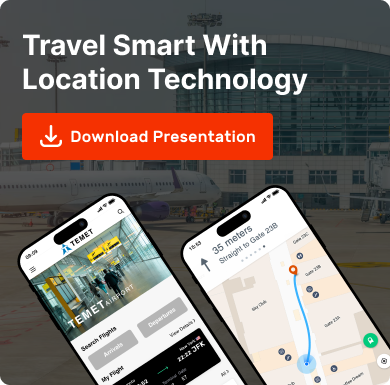
This particular challenge can be addressed effectively through the application of advanced technology. Mapsted’s cutting-edge hardware-free location technology and innovative minimal hardware IoT solutions for transportation hubs uses real-time analysis of people and assets to enhance situational awareness, gain insights into traffic patterns and optimize arrivals and departures. Mapsted’s location analytics platform is designed to forecast future operational conditions based on innovative insights. Mapsted has several unique selling points, including the ability to automate data collection and visualization using scalable technology. We also offer powerful pre-built analytics software designed specifically for airport managers and marketers.
6. Virtual and Augmented Reality
The augmented and virtual reality market in aviation increased significantly, with a value of USD 1,372 million in 2025. AR and VR technologies have a range of applications in the aviation industry, including training, maintenance and identifying potential dangers. These technologies provide an immersive and interactive approach that connects the aviation ecosystem to improve the efficiency of various tasks, leading to smoother operations and cost savings. The use of XR and Metaverse in aviation offers opportunities for enhanced customer experience, cost-effectiveness and a safer environment for learning and maintenance. As a result, airlines are expected to rapidly adopt these solutions to revamp the experience on air and land.
Moreover, Virtual Reality (VR) and Augmented Reality (AR) are not merely trendy terms for amplifying the training effectiveness of personnel and staff, but they also hold immense potential in providing unparalleled in-flight entertainment. Lufthansa conducted a trial of Avegant’s Glyph video glasses in the business lounge located at Frankfurt Airport, granting passengers a cinematic experience. These glasses were acknowledged with the Innovation Award Honoree at the CES technology tradeshow in 2017. In the future, more airports and airlines will work in tandem to engage passengers to increase seat upgrades by luring them with innovative technology.
7. IoT, 5G and Cloud
One of the most significant challenges encountered in air travel pertains to the aging infrastructure and the ceaseless struggle to keep pace with the escalating passenger count. Every year, queues lengthen, flights get overbooked and airport floorspace surpasses its capacity, thereby placing an excessive strain on airport infrastructure and exceeding sustainable standards for passengers and airport stakeholders.
In the United States alone, the average terminal is four decades old and by 2037, the global air passenger count is expected to reach 8.2 billion, highlighting the stark contrast between passenger growth and infrastructure readiness. To address this challenge, airports and airlines have collaboratively invested in enhancing their terminals to cater to future demands. Nevertheless, this modernization drive will have a disruptive effect on passengers as they will have to endure the chaos caused by ongoing construction activities.
Going forward, emerging technologies such as the Internet of Things (IoT), 5G, cloud and artificial intelligence (AI) will collectively facilitate sustainable airport operations, thus improving revenue opportunities, operational performance and passenger experience. In this context, Mapsted has already committed itself to airport modernization using hardware-free smart location technology. The company is revolutionizing airports with advanced indoor wayfinding and location marketing solutions that create business opportunities for airport-based enterprises and enable passengers to cater to their individual needs more efficiently.
In Closing
In 2025, current trends in the airline industry will see airports experiencing a surge in the use of automation and robotics, advanced air mobility, autonomous systems, data analytics and location intelligence, among other technologies. Smart robots, autonomous systems and analytics will enhance the passenger experience by streamlining security screening, baggage handling and floor management.
The industry will shift its funding focus from manned to unmanned AAM and sustainable aviation. Airports will rely heavily on data and technology to inform decision-making processes and advanced technology will use real-time location intelligence to enhance situational awareness. Furthermore, ChatGPT will revolutionize the customer experience by creating personalized itineraries for air travellers without the stress and hassle.
If you enjoyed this blog and would like to learn more about how location-based solutions can refine the passenger experience and operational capabilities at your airport, please check out our blog on “How to Enhance Customer Experience in Airports with Location-Based Technology“and our short video on how Mapsted technology is “Revolutionizing Airport Navigation at Miami International Airport.” Be the pioneer in leveraging cutting-edge airport location technology. Reach out to Mapsted today. Simply get in touch and request a free demo to witness the revolutionizing capabilities firsthand.
Frequently Asked Questions
Q1. What is AI in aviation industry?
Ans. AI in aviation industry refers to the use of artificial intelligence technologies such as machine learning and predictive analytics to optimize airport operations, improve passenger flow and enhance safety and efficiency.
Q2. How are airports using virtual and augmented reality technology?
Ans. How are airports using virtual and augmented reality technology?
Virtual and augmented reality technology can be used in airport operations to provide training simulations for staff, enhance the passenger experience by offering immersive entertainment options, and even assist with wayfinding and navigation throughout the airport.
Q3. What are the benefits of using artificial intelligence in airports?
Ans. Artificial intelligence (AI) in airports can be used to analyze passenger data and optimize operations in real time. This can help to improve efficiency, reduce waiting times, and enhance the overall passenger experience.
Q4. What is airport automation technology?
Ans. Airport automation technology involves using automated systems and machines to streamline airport operations, such as check-in, baggage handling, and security screening. This technology helps to improve efficiency and reduce waiting times for passengers.
Q5. What is the role of the Internet of Things (IoT) in airports?
Ans. IoT can be used in airports to collect and analyze real-time data from various devices and systems, such as security cameras, sensors, and passenger devices. This can help to improve operational efficiency, reduce costs, and enhance the overall passenger experience.
Q6. What are the latest airport technology trends shaping the aviation industry in 2026?
Ans. Airports in 2026 are adopting automation, biometrics, AI-driven operations, digital twins, IoT-based monitoring and cloud-based command centres to improve passenger flow, operational efficiency and safety. These technologies form the backbone of next-generation airport transformation initiatives.
Q7. How are airlines integrating technology to improve operations?
Ans. Airlines are syncing live aircraft data, crew information, passenger load forecasts and turnaround insights directly with airport systems. This integration optimizes gate planning, reduces delays and improves communication across the entire aviation ecosystem.
Q8. What is driving growth in the airport automation market?
Ans. The market is expanding due to rising passenger numbers, ageing airport infrastructure, demand for faster processing, safety requirements and the adoption of IoT, robotics and AI-powered systems that automate repetitive tasks and enhance terminal efficiency.
Q9. What is airport digital transformation?
Ans. Airport digital transformation is the integration of AI, IoT, cloud platforms and data analytics to modernize airport operations and improve passenger experience.
Q10. How does predictive analytics improve airport performance?
Ans. Predictive analytics helps airports anticipate congestion, delays and equipment failures. This enables proactive decision-making and smoother passenger journeys.
Q11. How does airport technology management support future scalability?
Ans. Effective technology management ensures airports can seamlessly adopt modular systems, strengthen cybersecurity, unify data sources and support automation — enabling scalable expansion without heavy physical upgrades.
Q12. What role do advanced airport technologies play in improving passenger experience?
Ans. Advanced technologies such as smart wayfinding, immersive AR guidance, biometric fast lanes and predictive queue systems reduce stress, shorten wait times and create smoother, more personalized journeys.


