


Hospitals & Healthcare
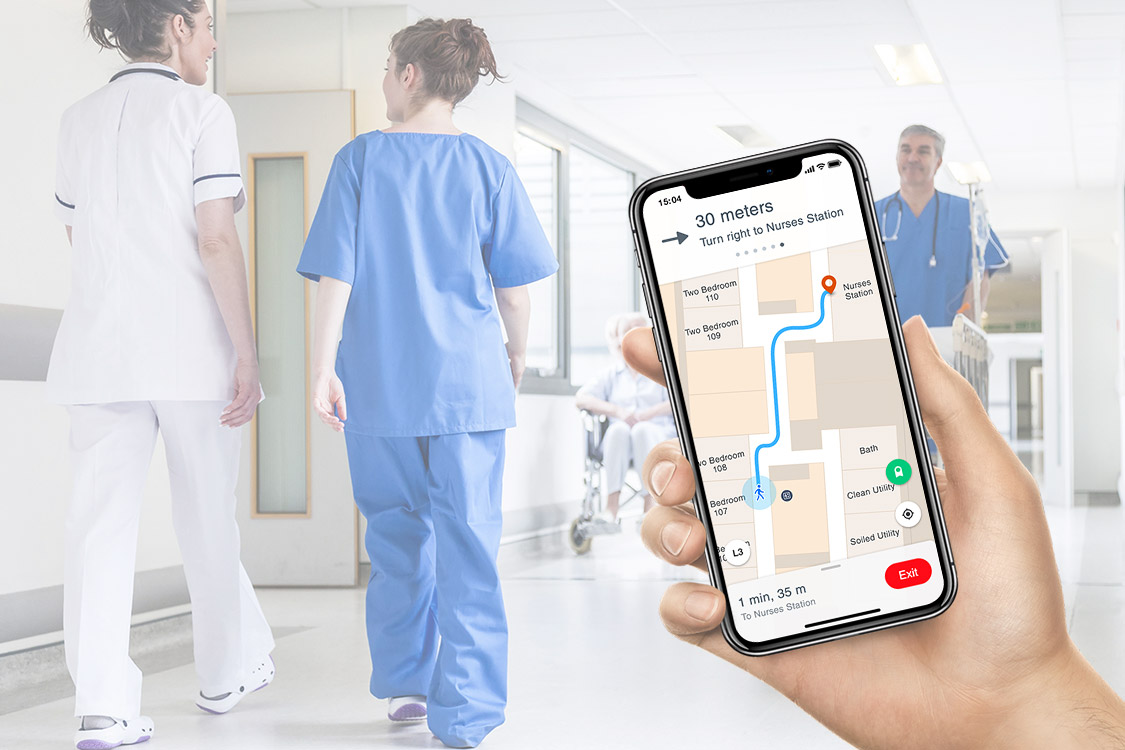
Let’s face it, few places are more confusing and anxiety-causing than airports and hospitals. Between the two, it’s probably fair to say that hospitals take top prize in confusion, wasted time and stress. So how can we improve the way the overall patient experience? One of the most important ways is through effective wayfinding systems in a hospitals.
Indoor wayfinding for hospitals is a sophisticated integration system of diverse technologies. These technologies can range from as simple as signposting to as complex as an indoor navigation app for mobile phones.
In a healthcare setting, wayfinding has the potential to provide more than just turn-by-turn directions and seamless navigation. It can also give us a 360-degree experience within a venue. In this way, strategic route-making is elevated – and that is the ultimate improvement one can seek.
How to improve wayfinding systems in hospitals?
Spatial Problem-Solving
Solving problems we face in a hospital or any space boils down to two things: human factors and technical factors.
The human factors are composed of what needs to be considered around the spatial problem. This forms the basis of the overall interior navigation plan. Obviously, the better the work is at the conceptual stage, the better the actualization will be.
The technical components of wayfinding are the physical and visual elements in the environment, such as:
- Color
- Lighting
- Architectural features
- Physical landmarks in the space
- Printed guides and maps
- Physical and digital signage
- Digital information kiosks
- Interactive maps and touchscreens
- Mobile indoor navigation apps
These elements enable our cognitive processes. Color, lighting, architectural features, and physical landmarks – we all instinctively understand those. Printed guides and maps – we all know how to use those. Let’s talk about the high-tech elements that can make a difference when navigating a hospital or healthcare facility.
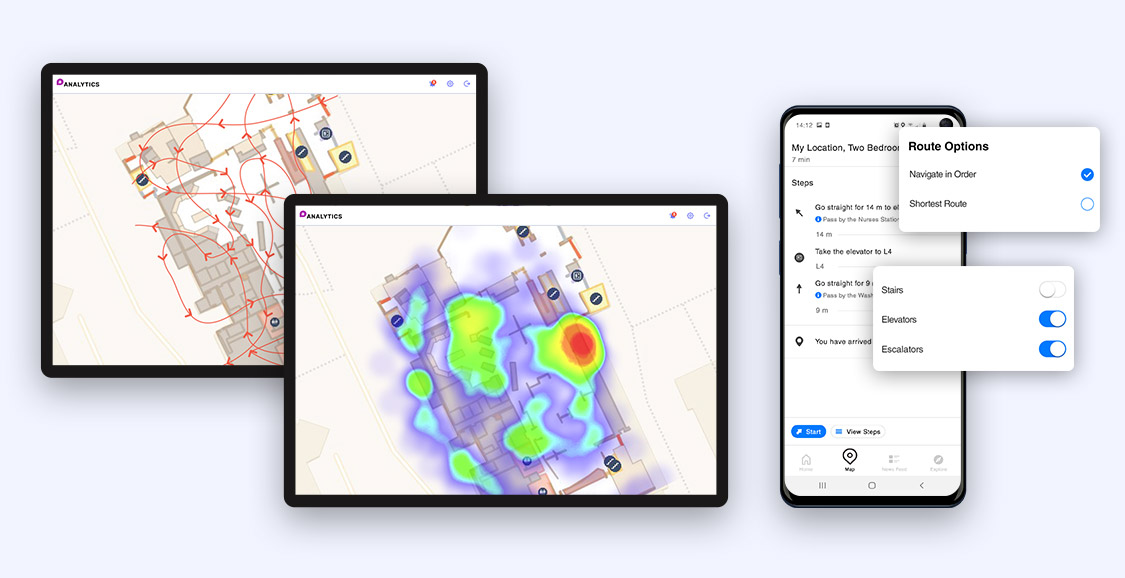
Enhancing Wayfinding systems in Hospitals
- Digital Signage
Digital signage is an innovation that’s intuitive and effective in virtually any setting. Alongside traditional signage, it can significantly augment the effectiveness of the whole signage scheme on hospital campuses. This technology can be configured to display everything from general notices to whose number is up to have blood drawn.
- Digital Kiosks
Locating specific rooms, departments, services and people in a healthcare facility can be made easy with digital information kiosks. Digital maps and more in-depth information are literally at the user’s fingertips. As opposed to printed materials, updates on digital kiosks can be made much more swiftly and with much less waste.
Indoor Navigation Apps for Hospitals
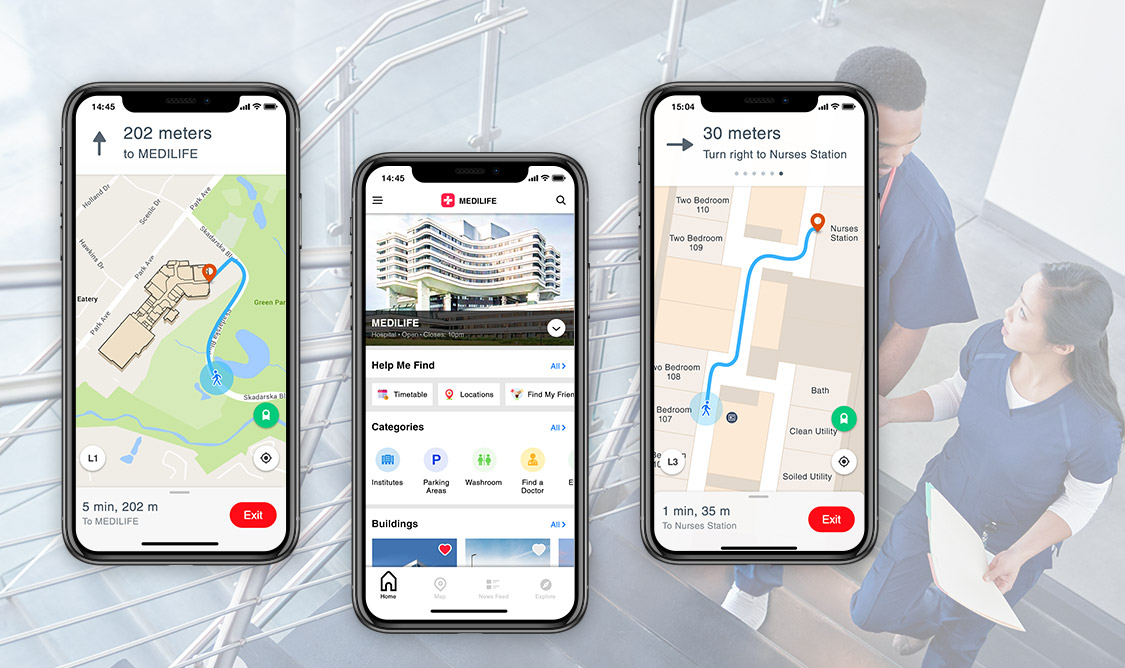
Of all the technological pieces, the bandwagon everyone seems to be jumping on is indoor navigation apps for mobile phones. And why not? We’re already in the habit of using GPS on our phones to find our way when we’re in the car. It’s an easy jump to assume we could use the same when we’re in a hospital, mall, or museum.
The benefits of a mobile app that leads you to your surgeon’s office are clear, but its usefulness reaches further. An indoor positioning app for healthcare campuses is like having a concierge in the palm of your hand. If you need a chocolate donut fix, some flowers, or a magazine, the app can take you there. With these kinds of capabilities, technology creates a truly comprehensive care experience.
5 Benefits of Implementing an Integrated Hospital Wayfinding Platform
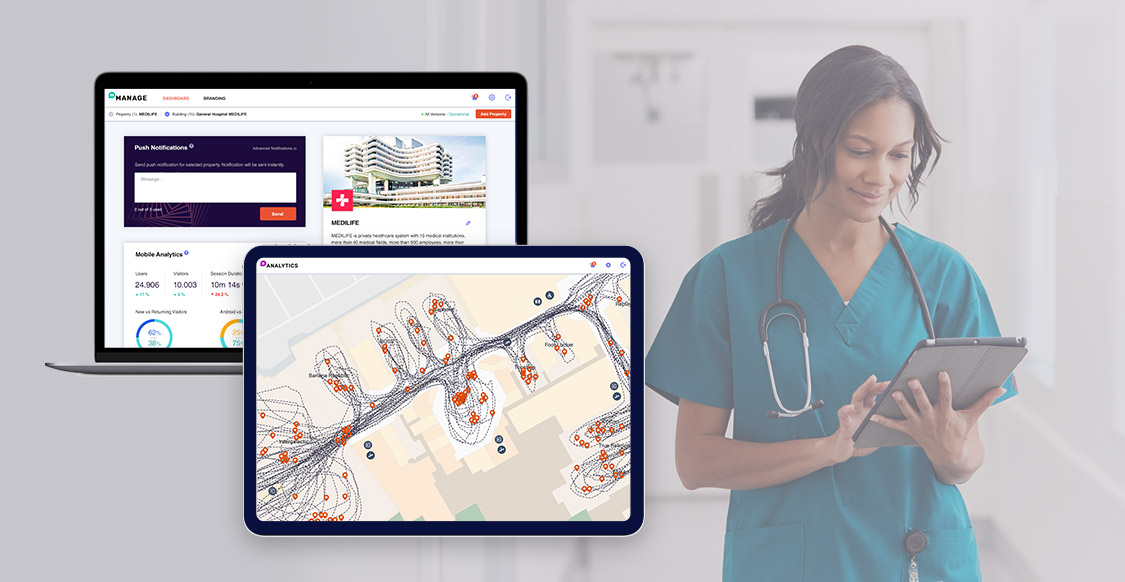
When it comes to the patients, visitors, and staff who navigate the multiple departments, common areas, and buildings in a hospital, the benefits of a well-planned, well-integrated wayfinding design are obvious. But the effects reach even farther. Hospitals themselves can get mileage from the positive results that come from a well-executed wayfinding solution on the healthcare campus.
Here are five ways successful wayfinding in healthcare facilities can benefit everyone, from those who roam the halls to those who manage the facility.
1. Reduces Stress, Frustration, and Anxiety
In an environment where emotions are already running high, it’s clear that lowering stress is good for everyone – patients, visitors, and healthcare workers alike. It’s interesting, then, that one of the biggest complaints by hospital visitors is frustration and anxiety over getting lost! One of the simplest ways to alleviate frustration on hospital campuses is an indoor navigation system that helps people to get where they want to go in the easiest way possible.
2. Saves Time for Patients, Visitors, and Staff
It goes without saying that when you find your way by the most direct route it saves time and frustration. In a hospital setting, saving time can have implications beyond the inconvenience factors — a life may depend on it. But whether a situation is life-threatening or not, time is always precious, no matter if you’re a patient trying to find your way to a department for tests, a visitor trying to find a loved one, a healthcare worker going at warp speed with a mission to accomplish, or a new staff member trying to get the lay of the land.
3. Enables Staff to be More Focused and Efficient
Now more than ever we are sensitive to the massive burden on healthcare workers. If we can find our way without having to ask for directions, that’s one less thing some overworked orderly has to do. For hospital staff, fewer interruptions mean greater focus and greater focus means greater efficiency. Staff is happier and more productive, and this ultimately improves the patient experience as well.
4. Reduces Congestion, Improves Traffic Flow, and Raises the Vibration
This benefit is closely tied to point 1 because reduced congestion and improved traffic flow contribute to a less stressful experience for living beings in an enclosed space. From the standpoint of facilities management, better traffic flow is a Holy Grail, no matter the nature of the venue.
But better flow is not just limited to the practical aspects of physical entities moving around a space; it affects the vibrational energy of the entities and space as well. Freeing up nodes of physical congestion has the higher-level impact of upgrading the collective vibe. It might not be stated that way in every management master plan. But raising the energy of a space and the people in it is an implicit goal of improving traffic flow. With patient experience and value-based care models taking on an important role in hospital philosophy and management, the macro-energetic aspect of wayfinding in the world of healthcare cannot be overlooked.
5. Increases Trust, Satisfaction, and Brand Identity
Now we’re getting into a more subtle realm of modern wayfinding in healthcare facilities, and an important one for hospital management. Besides the immediate effect of reducing stress and frustration, wayfinding technology in healthcare can have the lingering effect of boosting trust. The fact that management cared enough to make it easy for you to find your sister, find your surgeon, or find a Starbucks is not lost on people. This sort of positive impression translates to satisfaction, which leads to increased trust on the part of patients and visitors.
Conclusion
In the competitive acute-care market, an indoor navigation system that sorts out the difficulties between spaces and the people in them is an opportunity for a healthcare facility to stand out in the area of user experience. Ultimately, it’s a value proposition that can culminate in loyalty.
Mapsted is an industry leader and innovator in location-based indoor-outdoor navigation apps for hospitals and healthcare facilities. Our system is hardware-free and uses proprietary location technology that furnishes incredibly accurate real-time positioning. Our clients include prestigious healthcare centers around the globe.
Please contact us to find out how we can help you improve wayfinding in your healthcare facility.
If you would like to know more about how Mapsted’s solutions can elevate your facility, you will enjoy this short video on Maximize Hospital Efficiencies With Location Technology.
What’s Covered in This Blog
This blog explores the transformative role of wayfinding systems in hospitals, highlighting how they enhance patient experiences, streamline operations and bolster hospital branding. Key topics include:
- Understanding Wayfinding in Healthcare: An introduction to what wayfinding is in healthcare, its significance and its impact on patient navigation and satisfaction.
- Challenges in Hospital Navigation: Discussion on common navigation issues within hospital settings and the necessity for effective hospital wayfinding solutions.
- Technological Advancements: Insights into digital wayfinding in hospitals, including tools like interactive kiosks, mobile apps and digital signage that aid in navigation.
- Benefits of Integrated Systems: Examination of the advantages of comprehensive hospital wayfinding systems, such as reduced stress, improved efficiency and enhanced patient trust.
- Implementation Strategies: Guidance on adopting hospital wayfinding technology, focusing on user-centric design and integration with existing hospital infrastructure.
- Case Studies and Real-World Applications: Examples illustrating the successful deployment of wayfinding for healthcare facilities and the positive outcomes achieved.
Frequently Asked Questions
Q1. What is wayfinding in healthcare?
Ans. Wayfinding in healthcare refers to the systems and strategies that assist patients, visitors and staff in navigating complex hospital environments. This includes signage, maps, digital directories and mobile applications designed to guide individuals efficiently to their destinations.
Q2. How do wayfinding systems in hospitals improve patient experience?
Ans. Implementing wayfinding systems in hospitals reduces confusion and anxiety by providing clear navigation paths. This leads to timely arrivals for appointments, decreased stress levels and an overall enhanced patient experience.
Q3. What are the benefits of digital wayfinding in hospitals?
Ans. Digital wayfinding in hospitals offers real-time navigation assistance, updates on facility changes and personalized routes. It minimizes the need for staff intervention, reduces missed appointments and improves operational efficiency.
Q4. How do hospital wayfinding solutions benefit hospital staff?
Ans. Effective hospital wayfinding solutions alleviate the burden on staff by decreasing the frequency of directional inquiries. This allows healthcare professionals to focus more on patient care, enhancing productivity and job satisfaction.
Q5. What technologies are involved in hospital wayfinding systems?
Ans. Modern hospital wayfinding systems incorporate technologies such as interactive kiosks, mobile navigation apps, digital signage and sometimes augmented reality. These tools provide intuitive and accessible navigation assistance to users.
Q6. How does hospital wayfinding technology enhance operational efficiency?
Ans. By streamlining navigation, hospital wayfinding technology reduces delays, prevents bottlenecks and ensures smoother patient flow. This optimization leads to better resource utilization and improved overall hospital operations.
Q7. Are wayfinding systems adaptable to different healthcare facilities?
Ans. Yes, wayfinding for healthcare facilities is customizable to suit various layouts and sizes. Solutions can be tailored to meet the specific needs of different departments, ensuring effective navigation across diverse healthcare settings.


